Volume Rhythm Indicator
A custom-built trading indicator designed to turn volume behaviour into a clearer and more useful visual rhythm.

Explore a selection of websites, digital platforms, WordPress solutions and custom builds created to solve real business problems and move ideas into action.
A selection of digital products, websites and custom solutions built around specific ideas, challenges and business needs.
A custom-built trading indicator designed to turn volume behaviour into a clearer and more useful visual rhythm.
A place for another project that demonstrates how StudioSCoops turns specific requirements into practical digital solutions.
Another selected build can be featured here with its own visual, context and the problem it was designed to solve.
A custom system, automation or tool designed to make a specific process simpler and more efficient.
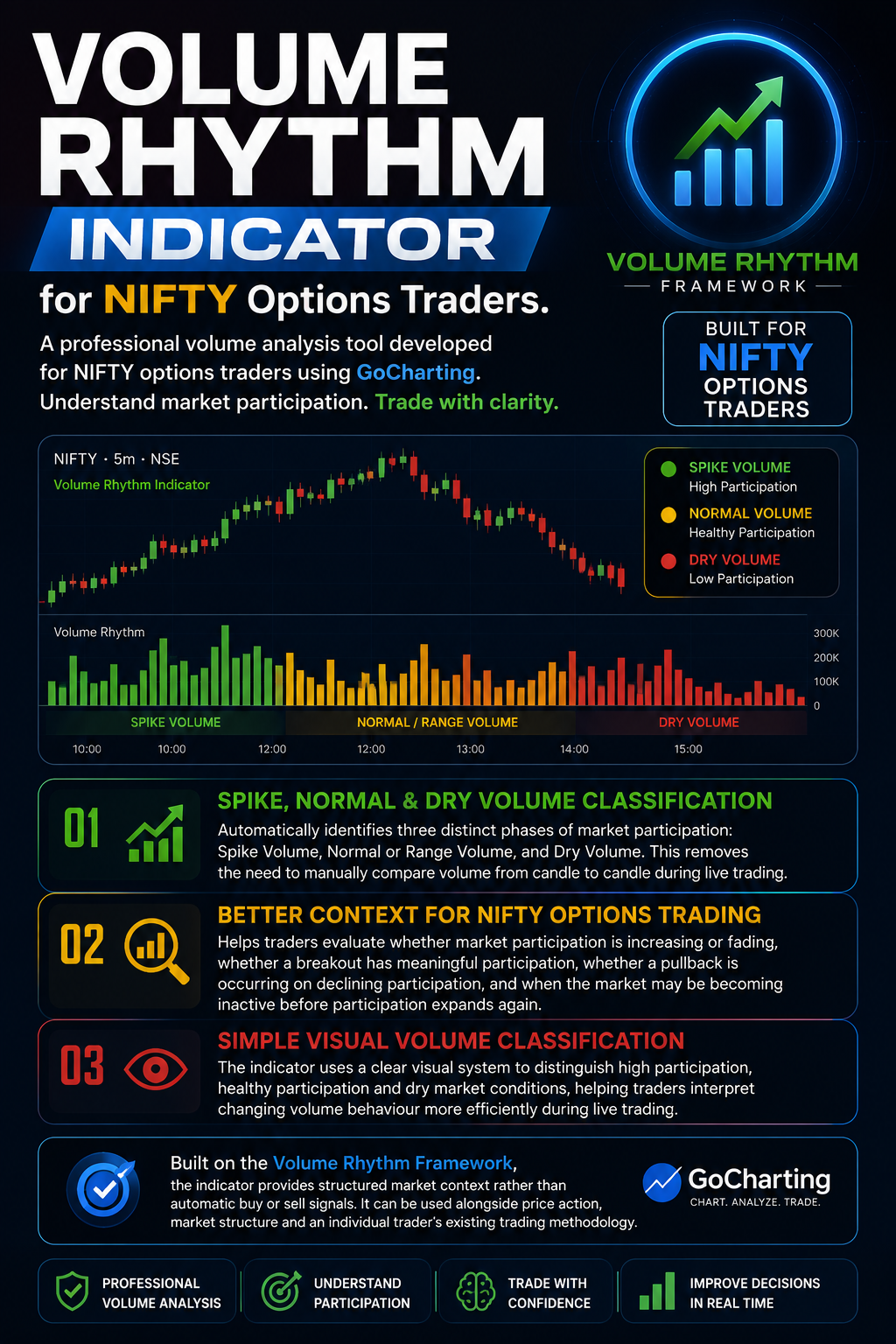
The Volume Rhythm Indicator is a professional volume analysis tool developed for NIFTY options traders using GoCharting. It automatically classifies every candle by market participation, helping traders understand when participation is expanding, remaining healthy or drying up during live market conditions.
Automatically identifies three distinct phases of market participation: Spike Volume, Normal or Range Volume, and Dry Volume. This removes the need to manually compare volume from candle to candle during live trading.
Helps traders evaluate whether market participation is increasing or fading, whether a breakout has meaningful participation, whether a pullback is occurring on declining participation, and when the market may be becoming inactive before participation expands again.
The indicator uses a clear visual system to distinguish high participation, healthy participation and dry market conditions, helping traders interpret changing volume behaviour more efficiently during live trading.
Built on the Volume Rhythm Framework, the indicator provides structured market context rather than automatic buy or sell signals. It can be used alongside price action, market structure and an individual trader's existing trading methodology.
From custom WordPress plugins and vehicle lookup tools to calculators, automation and everyday utilities, these builds focus on solving specific problems with practical functionality.
Add structured custom fields to WordPress pages, posts and custom post types without manually editing templates.
A custom vehicle lookup workflow designed for UK garages to retrieve vehicle information and support service history processes.
Automatically generate downloadable PDF invoices from WordPress forms, WooCommerce orders or custom business workflows.
A configurable calculator that lets visitors select services, quantities and options to receive an instant estimated cost.
Turn WordPress form submissions into structured PDF documents and automatically deliver them by email.
A simple browser-based utility for resizing and preparing multiple images for websites, social media and digital use.
Custom technology is most valuable when it solves a specific operational problem, removes unnecessary work or creates a capability your business doesn't currently have.
The best starting point is rarely “What technology should we use?” It is “What business problem is worth solving?”
Answers to common questions about custom WordPress development, web applications, plugins, integrations, automation and digital products.
A business should consider custom development when existing software creates too many workarounds, cannot support an important workflow, requires repetitive manual work or does not integrate with essential systems. A custom solution can be designed around the way the business actually operates instead of forcing the business to adapt to software limitations.
An existing WordPress plugin is usually the right choice for standard functionality. A custom WordPress plugin becomes a better option when the required functionality is specific to your business, existing plugins include unnecessary features, create compatibility issues or cannot support a required workflow or integration.
Yes. A repeated internal process involving data, approvals, calculations, customer interactions or team workflows can often be developed into a web application, dashboard, internal tool or digital product. The first step is identifying the core problem, users and workflow the solution needs to support.
Yes. Custom development can connect websites, web applications and business tools with existing systems through APIs, databases and third-party integrations. This can reduce duplicate data entry, improve information flow and automate actions between systems.
In many cases, yes. A custom build does not always require replacing an existing website. New functionality, custom WordPress plugins, dashboards, integrations or automated workflows can often be added to an existing platform, depending on its technical structure and requirements.
The cost of a custom development project depends on the complexity of the functionality, number of user workflows, integrations, technical requirements and testing involved. A focused custom feature may require a smaller project, while a web application or multi-user platform usually requires more planning and development. The best way to estimate cost is to first understand what the solution needs to do.
You do not need a complete technical specification before starting. A useful starting point is a clear explanation of the problem, who will use the solution, how the current process works and what you want to improve or achieve. From there, the functionality and technical requirements can be defined.
A custom build may be worth considering when your team spends significant time on manual work, important systems do not work together, existing software cannot support a critical requirement or you have a process that could become a scalable digital product. The decision should start with the business problem and expected value, not the technology itself.
You do not need a technical specification, a complete feature list or a finished plan. Tell us what you are trying to improve, automate, connect or create, and we can help determine the right way to build it.
The right solution starts with understanding what needs to change.